
The EU Pay Transparency Directive After the Deadline: What Employers Need to Do Now
The implementation deadline for the EU Pay Transparency Directive (the “Directive”) passed on 7 June 2026, but only four EU Member States – Italy, Lithuania, Malta and Slovakia – have so far adopted comprehensive implementing legislation. The others were either still consulting on draft laws or had not yet published full proposals.
Given the number of non-compliant Member States, considerable uncertainty remains for employers.
While the Directive sets the minimum standard, the detail still depends on the law adopted in each country. Some governments may also keep existing domestic rules or impose requirements that go further than the EU baseline.
However, that uncertainty is not a reason to wait. The Directive’s core requirements are clear enough to guide preparation now. The draft legislation published so far suggests that some countries will stay close to the EU baseline, while others will build on existing equal pay and pay reporting rules.
Businesses that wait for every national law to be finalised may leave themselves too little time to identify and address pay issues, update internal systems and prepare for the reporting and information obligations that will follow.
Directive Aims and Provisions
- The Directive strengthens equal pay for equal work, and for work of equal value between men and women by increasing transparency at recruitment, during employment, and through reporting and enforcement.
- At recruitment, employers must give applicants information about the initial pay or pay range before interview. They must not ask about current or previous pay, and recruitment processes must be non-discriminatory.
- During employment, workers must be able to access the criteria used to determine pay and pay progression. They must also be able to request information about their own pay and average pay levels, broken down by sex, for workers doing the same work or work of equal value. Employers must also remove restrictions on pay discussions, including pay secrecy provisions.
- For larger employers, the Directive introduces gender pay gap reporting. Employers with 250+ workers must report annually from 2027. Employers with 150–249 workers must report every three years from 2027, and employers with 100–149 workers every three years from 2031. If reporting identifies an unjustified pay gap of 5% or more in any worker category that is not corrected within six months, the employer must carry out a joint pay assessment with worker representatives.
- The Directive also strengthens enforcement. Member States must introduce penalties, workers must have access to compensation, and the burden of proof may in some cases shift to the employer. It is therefore not just a reporting exercise, but is intended to change how pay is set, reviewed and explained.
Gender Pay Gap Reporting Thresholds
| Employer size | Reporting cycle | Start date |
|---|---|---|
| 250+ workers | Annually | From 2027 |
| 150–249 workers | Every three years | From 2027 |
| 100–149 workers | Every three years | From 2031 |
The Latest Position of Member State Implementation
Only four Member States – Italy, Lithuania, Malta and Slovakia – adopted comprehensive implementing legislation in time for 7 June 2026.
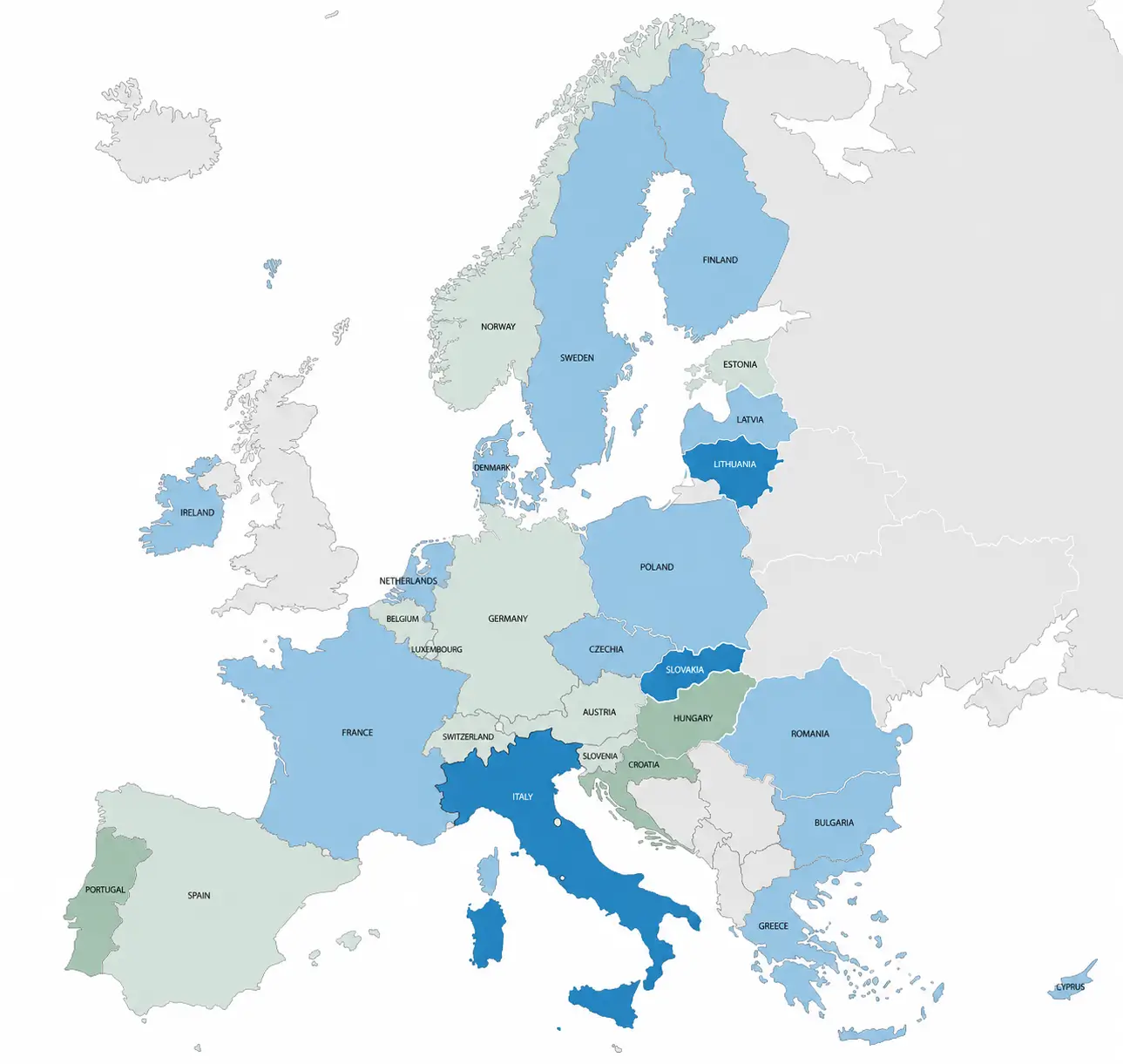
Transposition Stage
Full transposition
Draft published
Official Initial steps announced
No activity on official government sites announced
Several others have published draft laws or completed consultations but have not yet passed final legislation. Some, including the Netherlands, Sweden, Czechia, and Denmark, have already indicated that implementation will be delayed until 1 January 2027.
In several Member States, no comprehensive draft legislation has yet been made public.
The position is made more complex by some Member States already having domestic rules covering parts of pay transparency, such as salary disclosure, pay secrecy restrictions or gender pay gap reporting. Others have introduced partial measures but will still need further legislation before the full framework is in place.
It is likely there will be significant variation between Member States. The Directive sets minimum standards, but national governments can go further. Local laws may apply to smaller employers, require additional pay information, impose shorter reporting cycles or introduce broader consultation and enforcement requirements.
Employers will therefore need to assess the final rules in each relevant jurisdiction rather than relying on a single EU-wide approach.
What Should Global Employers Be Doing to Prepare?
- Establish a reliable pay-data baseline: Employers should ensure they can bring together reliable pay and benefits data across the relevant parts of the business and analyse it by sex and worker category. Any gaps or inconsistencies across payroll, HR or compensation systems should be addressed now, as they may affect reporting and worker information requests.
- Review pay structures and decision-making: Employers should review how starting salaries, pay increases, bonuses and benefits are determined and whether those decisions can be explained by objective, gender-neutral criteria. This should also include reviewing where decisions are highly discretionary or poorly documented, and how the business identifies roles involving the same work or work of equal value.
- Check recruitment processes: Recruitment processes should be reviewed now rather than once local laws take effect. Employers should check when and how salary ranges are communicated, whether candidates are still asked about current or previous pay, and whether job titles, adverts or interview practices could create equal pay risk. Recruitment teams should also be clear on how to respond to questions about pay and progression.
- Investigate unexplained gaps early: Do not wait for formal reporting obligations before analysing pay differences. Any gaps that cannot be clearly explained by legitimate, objective factors should be investigated and, where necessary, addressed. This is particularly important because the first reporting obligations for larger employers arise in 2027 and may rely on 2026 pay data.
- Prepare the business internally: HR teams, recruiters, managers and other relevant stakeholders should understand the changes and their role in implementing them. That includes training, internal communications and planning for engagement with works councils, trade unions and other worker representatives where consultation or involvement may be required.
- Monitor national implementation: Employers should continue to track developments in each Member State in which they operate. A single EU-wide approach may be a useful starting point, but it will not remove the need for local review. Businesses that wait for every national law to be finalised may leave themselves too little time to analyse pay data, address issues, update systems and make the changes needed before the new obligations take effect.
The UK Position
Following Brexit, the UK is not required to implement the Directive. Employers must instead continue to comply with the UK’s existing equal pay and gender pay gap reporting rules.
Under that framework, employees are entitled to equal contractual pay and benefits where they do like work, work rated as equivalent, or work of equal value. Employers with 250+ employees must also publish prescribed gender pay gap data annually.
The UK regime does not currently include the Directive’s wider recruitment-stage transparency or individual pay information rights, although mandatory gender pay gap action plans for large employers are expected from spring 2027.
The Directive will remain directly relevant to UK businesses with operations in the EU and may also increase expectations among UK employees for greater transparency around pay practices and decision-making.
How iGlobal Can Help
We are already supporting several clients with reviewing and adapting their pay structures and practices in preparation for the Directive’s minimum standards and anticipated national requirements.
Drawing on our international reach and experience coordinating complex cross-border projects, we can support businesses at every stage of preparation, from initial compliance and gap analysis through to the development and implementation of practical changes.
To discuss how we can support your business, please contact us at sam.thompson@igloballaw.com.
Member State Implementation Status
| Member State | Status | Draft legislation | Final legislation | Further comments |
|---|---|---|---|---|
| Austria | Not transposed | No | No | No public draft had been published by the deadline. Negotiations with social partners were ongoing. Existing rules already require minimum salary information in job adverts and biannual income reports for employers with 150 or more employees. |
| Belgium | Partial / incomplete | Partial | Partial | Federal private-sector transposition remains incomplete after negotiations stalled. Partial measures exist in parts of the public sector. Belgium also has existing equal-pay and gender pay-gap reporting rules, including biannual reporting for employers with 50 or more employees. |
| Bulgaria | Draft legislation | Yes | No | A draft entered public consultation on 19 May 2026. It is presented as a minimum implementation, although some provisions appear more prescriptive, including stronger oversight and limited exemptions for smaller employers. |
| Croatia | No public measures | No | No | No public draft or formal transposition activity had been identified by the deadline. |
| Cyprus | Draft legislation | Yes | No | A draft bill has been published covering pay transparency and enforcement. It broadly follows the Directive, with local provisions on sanctions and enforcement bodies. |
| Czechia | Draft legislation; delayed implementation | Yes | No | Draft legislation was introduced in March 2026 and is expected to take effect on 1 January 2027. A ban on salary-history enquiries has already been introduced, but the wider package remains pending. |
| Denmark | Draft legislation; delayed implementation | Yes | No | Draft legislation was published in early 2026, with implementation planned for 1 January 2027. The draft broadly follows the Directive but may go further in some areas. |
| Estonia | Partial preparatory measures | Partial | No | Estonia sought delay because of administrative burden but moved to preserve certain recruitment-stage rights, including a salary-history ban and the right to initial pay information before interview. Full transposition remains outstanding. |
| Finland | Draft legislation | Yes | No | Draft legislation was published in May 2025 but had not been enacted by the deadline. It broadly follows the Directive, although further work appears necessary to cover all requirements. |
| France | Draft legislation | Yes | No | Draft laws were circulated in March and June 2026. Proposed measures go beyond the Directive in some respects, including a 50-employee reporting threshold and salary ranges in job adverts. France already operates the Gender Equality Index for employers with 50 or more employees. |
| Germany | No final draft | No final draft | No | Policy work and recommendations had been produced, but no implementing law was in force by the deadline. Germany’s existing Pay Transparency Act 2017 is less extensive than the Directive, so further legislation is required. |
| Greece | Draft legislation | Yes | No | Draft legislation was published and put out for consultation in early June 2026. It broadly follows the Directive and gives a significant role to collective labour agreements. |
| Hungary | No public measures | No | No | No public bill or clear implementation step had been identified by the deadline. |
| Ireland | Partial draft and existing reporting regime | Partial | No | Draft legislation published in January 2025 covers parts of the Directive, principally salary ranges in job adverts and a salary-history ban. Ireland already requires gender pay-gap reporting for organizations with more than 50 employees, but further legislation is needed for full transposition. |
| Italy | Fully transposed | Yes | Yes | Legislative Decree No. 96 of 7 May 2026 was published on 1 June 2026 and took effect on 7 June 2026. The legislation gives a central role to national collective bargaining agreements and adopts a narrower definition of pay in some respects. Italy has transposed the Directive’s core requirements, with further detail to follow through implementing decrees and guidance. Key features include salary information in job adverts, use of collective bargaining classifications to assess work of equal value, an annual limit on pay information requests, and a narrow definition of “pay level” for reporting purposes. |
| Latvia | Draft legislation | Yes | No | A standalone Pay Transparency Law was published on 26 March 2026. It still requires Cabinet and parliamentary approval as of the deadline passing. |
| Lithuania | Substantially transposed | Yes | Yes | Lithuania has fully transposed the Directive, with the main provisions taking effect from 7 June 2026 and more complex obligations phased in through 2027. Its approach goes beyond the minimum requirements by introducing centralised reporting through Sodra, monthly employer data submissions and shorter response deadlines, with further implementing rules due by 31 July 2026. |
| Luxembourg | Preliminary work only | No official draft | No | A preliminary draft was under consultation within the Ministry of Labour, but no official bill had been filed by mid-May 2026. |
| Malta | Fully transposed | Yes | Yes | Malta fully transposed the Directive through regulations published on 5 June 2026, which took immediate effect. The new framework covers all Directive requirements and updates the recruitment-stage and pay information rules partially introduced in August 2025, including extending information rights to work of equal value and requiring gender-disaggregated data. |
| Netherlands | Draft legislation; delayed implementation | Yes | No | Revised draft legislation was submitted to the House of Representatives in May 2026. The government has confirmed that implementation will be delayed until 1 January 2027. The draft also strengthens the role of works councils. |
| Poland | Partially transposed | Yes | Partial | Poland has partially transposed the Directive through recruitment-stage transparency rules in force since 24 December 2025. An updated draft covering the remaining requirements was published on 4 May 2026 and remains in the legislative process. The draft would take effect six months after publication and retains a 30-day deadline for responding to pay information requests. |
| Portugal | No public draft | No | No | No public implementing draft had been identified by the deadline. Portugal already has equal-pay legislation, including Law 60/2018, but full Directive transposition remains outstanding. |
| Romania | Draft legislation; delay likely | Yes | No | Draft legislation was published on 30 March 2026. Subsequent political instability made delay likely. The draft broadly follows the Directive and shortens the response period for certain information requests. |
| Slovakia | Fully transposed | Yes | Yes | Slovakia has fully transposed the Directive. The Act on Equal Remuneration of Men and Women for Equal Work or Work of Equal Value took effect on 7 June 2026. The first reporting date for employers with 100–249 employees may, however, be later than the Directive’s minimum timetable. Its approach broadly follows the EU minimum requirements while adding clearer procedures, stronger worker protections and specific enforcement mechanisms. |
| Slovenia | Preparatory stage | No public draft | No | A working group had been established to prepare legislation, but no public draft or timetable had been announced. |
| Spain | Consultation stage | Consultation only | No | A prior consultation was launched in April 2026, but no draft text had been published by the deadline 2026. Spain already has extensive pay-register, pay-audit and equality-plan requirements, but full Directive transposition remains outstanding. |
| Sweden | Draft suspended; implementation delayed | Earlier draft | No | Draft amendments had been prepared, but the process was suspended in March 2026 while Sweden sought postponement and renegotiation at EU level. Sweden already requires annual equal-pay surveys and analysis under the Discrimination Act. |
For more information, contact info@igloballaw.com.